Apple rejected Inner Flare under App Store Guideline 1.4.1, Safety: Physical Harm. The note was short. The app shows health information, it doesn't say where that information comes from, and it needs citations that are easy for the user to find.
It was a fair rejection. The app had a "not a medical device" statement and caveats on every estimate, but no sources. A disclaimer tells you how far to trust a number. A citation lets you check it yourself. We had the first and not the second.
Most of the app needed no citation
The first step was an audit: every place the app makes a claim that isn't just your own data played back to you.
That list was shorter than expected. Average cycle length, variability, days since your last period, the gauges, the trend charts and the cycle history table are all arithmetic on the dates you log. Nobody needs a journal article to trust a mean. What those need is a plain description of the calculation, and they now have one.
Everything that does need a source came from four constants in one file:
- the fertile window is the five days before ovulation plus the day itself
- ovulation happens 14 days before the next period
- a period lasts about 5 days
- cycles that differ by more than 7 days are irregular
Four numbers, all general claims about how menstrual cycles work, built into every prediction the app makes.
One of our assumptions was weaker than we'd written down
The code comment above the 14 day constant called it "the standard clinical estimate". That's what most cycle trackers assume, and the American College of Obstetricians and Gynecologists does say ovulation happens about 14 days before the next period in an average 28 day cycle.
Reading the primary research changed how much weight that number can carry. In Wilcox and colleagues' 2000 BMJ study, which tracked ovulation with daily hormone measurements, women with 28 day cycles ovulated exactly 14 days before their next period in only 10% of those cycles. The gap ranged from 7 to 19 days. A 2019 analysis of more than 600,000 cycles found a mean of 12.4 days. The BMJ authors' conclusion is the line worth quoting: "the timing of their fertile window can be highly unpredictable, even if their cycles are usually regular."
So 14 days is an average, not a clinical constant. Citing it without the range would have meant pointing at a source that argues against our own wording. The fertile window caveat used to say "An estimate, not a reliable method of contraception." It now says what the estimate assumes and how much that assumption varies:
Assumes ovulation about 14 days before your next period. In reality this varies from about 7 to 19 days, so treat this as a rough guide, not contraception.
The other three held up better. The five day fertile window comes from Wilcox's 1995 NEJM study, which found conception only from intercourse in a six day window ending on ovulation day. The 7 day irregularity threshold is the strict end of the 7 to 9 day range used by ACOG and FIGO, where the limit depends on age. Inner Flare applies 7 days to everyone and now says so.
What changed in the app
There's a new screen, "How estimates work". For each estimate it says how the calculation works, what the research says about the assumption behind it (including the range, not just the headline number), and the full citation. Citations are written out in full, so they're readable offline. Tapping one opens the original publication in your browser.
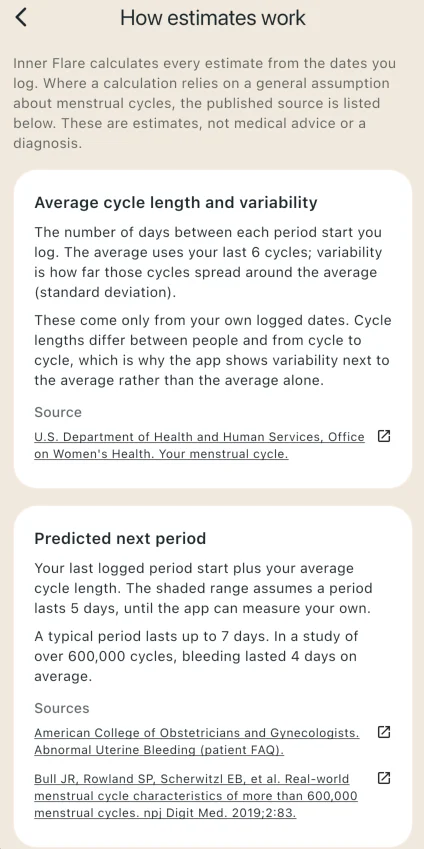
You can reach it four ways: an info button on Insights, a "How is this calculated?" link under each prediction, the Calendar legend, and Settings under About. It doesn't depend on having logged anything, because the time to decide whether to trust an estimate is before you rely on it.
We link to the primary sources, not to a summary on our own site. The trust belongs to ACOG, the BMJ, the NEJM and the researchers who did the work, not to us. If we've misread something, you can see that for yourself.
Offline still means offline
Inner Flare has no internet permission, and CI fails the build if a URL shows up anywhere in the source without a written justification. Seven new URLs needed exactly that. They all live in one file with a comment explaining why, and a link only opens when you tap it, handed to your system browser. The app never fetches anything itself.
The citations are also tested. A unit test fails if any estimate loses its source, if a link isn't https, or if a source points at our own domain instead of the original. The project rules now say that changing an assumption or its wording means updating its citation in the same change.
The point
Inner Flare's pitch has always been that predictions are plain statistics you can check, not an opaque model you have to trust. Until this week that was true of the arithmetic and not of the assumptions underneath it. App Review caught the gap. Fixing it properly also fixed a claim in our own code that the research didn't support.
The full list of sources is in the app, and in the source code. If you think we've misread any of them, tell us.